Which organisations is commercial solar for?
Any business or organisation in and around Glasgow with a suitable roof or land and a steady daytime electricity demand can benefit from commercial solar. This includes offices and retail units (daytime opening hours align with solar generation), warehouses and industrial units (large, low-pitched roofs and steady machinery or lighting loads), hospitality businesses (hotels, restaurants and bars with kitchens and cooling running through the day), schools and community buildings, and farms with barns, sheds and spare land.
The key factor is daytime electricity usage. The more electricity you use while the sun is up, the more of your solar generation replaces grid power at the full retail rate. A site survey confirms your roof, usage and grid connection.
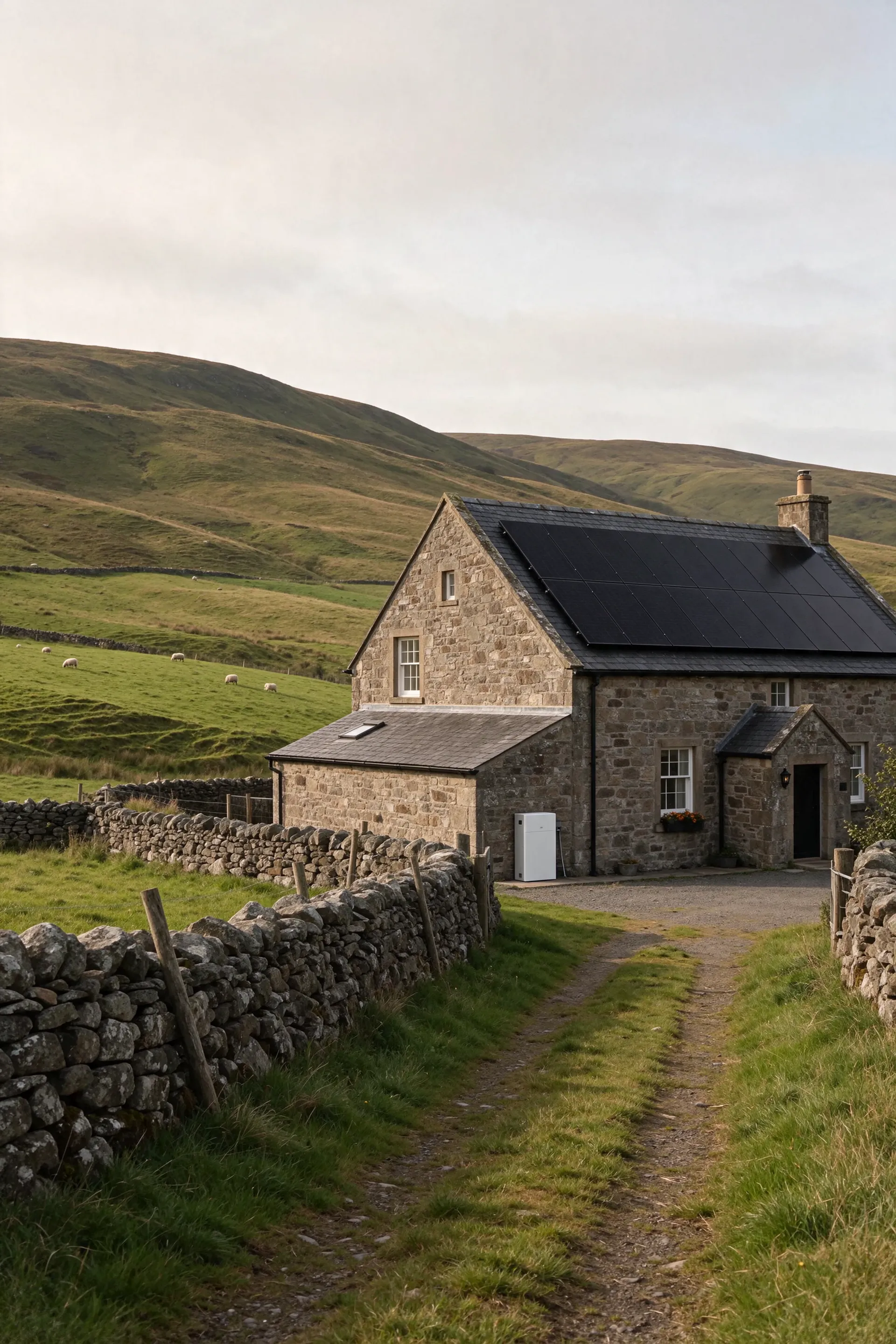
Farms across the west of Scotland — from dairy farms with cooling loads to arable farms with drying or workshop demands — often have suitable roof space on barns and outbuildings, or ground-mounted arrays where there is suitable land.
How does commercial solar save a business money?
Every unit your panels generate and you use on site is a unit you do not buy from your supplier. The value of that saving depends on your tariff (the unit rate you pay), your usage pattern (how much you use during daylight hours), your roof or ground space (how large the system can be), and what you earn for exported power.
A battery can increase savings by storing surplus daytime generation for evening shifts, peak-rate periods or heavy equipment. It can also smooth demand on sites with variable loads.
Your site survey models these factors for your specific premises. The written proposal sets out the figures for your business rather than general estimates. We do not publish general savings estimates because commercial situations vary too widely.
Do larger commercial systems need grid permission?
Usually, yes. In Glasgow and the west of Scotland, SP Energy Networks must approve larger grid connections, normally through a G99 application before installation. Systems up to 3.68kW single-phase use the fast-track G98 form, but most commercial systems exceed this threshold.
Your installation partner handles the G99 application and any network studies. The timeline is built into your project plan so there are no surprises on start dates. The survey assesses your current grid connection and what will be needed.
For very large systems, network reinforcement may be required, which the G99 process identifies. This is discussed and agreed before any installation work begins.
What about battery storage and EV charging for businesses?
Battery storage for commercial premises stores surplus daytime solar power for evening shifts, peak-rate periods or heavy equipment. It can also smooth demand on sites with variable loads, reducing peak-demand charges on some commercial tariffs.
EV charging can be installed alongside solar, with chargers for company vehicles, staff and visitors. Where solar is present, EV charging can run partly on your own generated electricity, reducing the cost of fleet charging.
Heat pumps for larger buildings — offices, halls, commercial premises — are also available through our MCS-certified partner. Vaillant air source heat pumps can be sized for commercial hot water and space heating demands.
How do I get a commercial solar proposal?
Start by filling in the business enquiry form on our commercial solar page, or call 0141 230 0198. A specialist visits your site to look at your roof or land, your electrics, meter data and grid connection. This is the site survey.
After the survey, the system is designed around your usage and space, and you receive a written proposal with pricing, projected generation and finance terms if required. There is no obligation — you decide whether to proceed.
If you proceed, installation is carried out through our MCS-certified partners, scheduled to keep disruption to your business low. Aftercare includes monitoring, servicing and a single point of contact once your system is running.