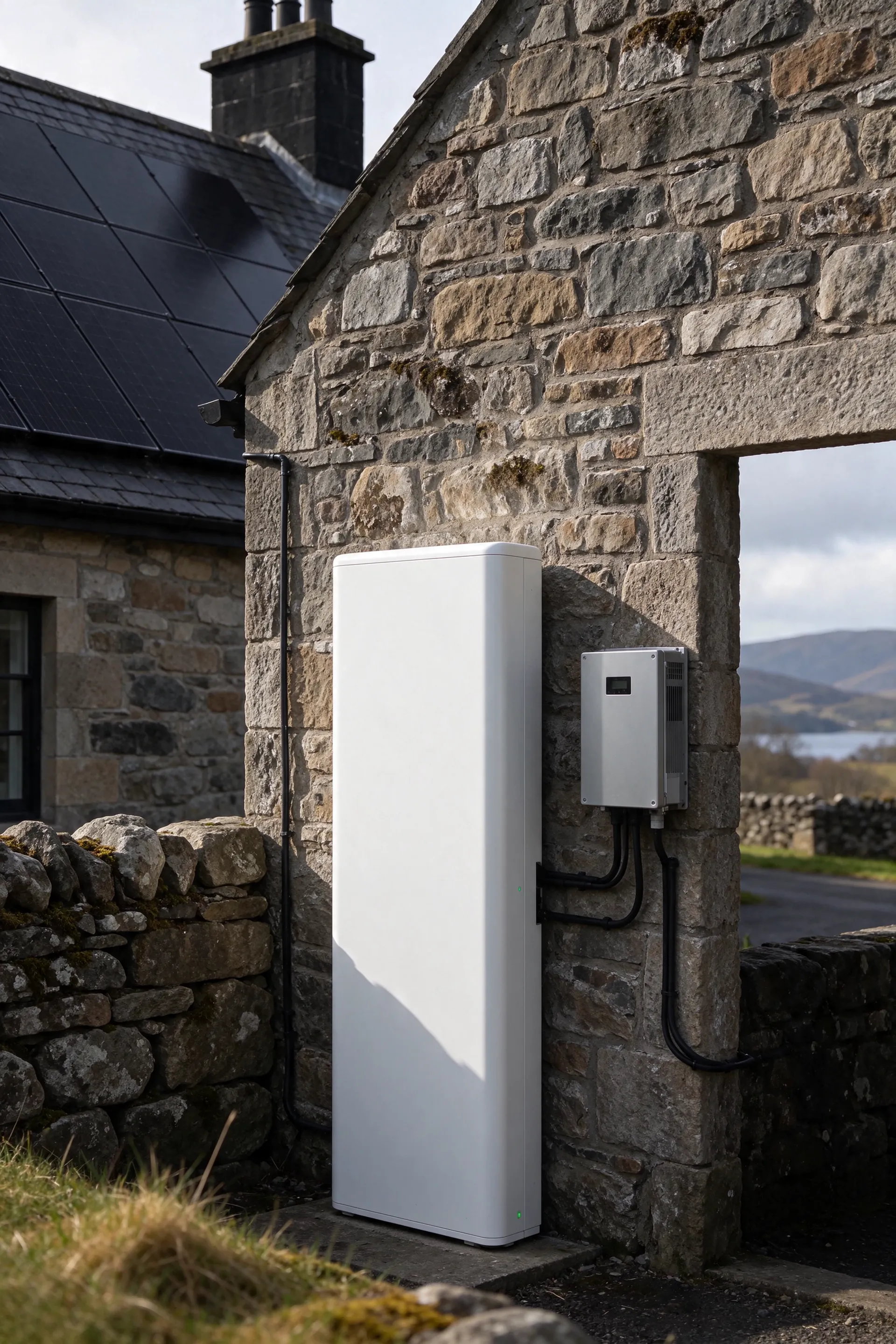
What does a solar battery actually do?
A home battery stores surplus solar electricity that your panels generate but your home does not use at that moment. Without a battery, that surplus is exported to the grid at the SEG export rate — currently ranging from roughly 1p to 25p per kWh. With a battery, the surplus is stored and used in the evening when you would otherwise buy electricity from the grid at the full retail rate (around 25–30p per kWh).
The battery also works independently of solar. On a time-of-use tariff, it can charge from the grid overnight at the off-peak rate (around 7–9p per kWh on some tariffs) and discharge during peak hours. This is called grid arbitrage, and it is particularly valuable in Scotland where solar surplus is concentrated in summer but the peak/off-peak spread is available year-round.
The Hanchu LiFePO4 battery specified through Glasgow Solar City uses lithium iron phosphate chemistry, known for long cycle life and thermal stability. It has 95% depth of discharge (meaning 95% of stored energy is usable), approximately 8,000 charge cycles, a 22-year design life and a 10-year warranty.
When is a battery worth it in Scotland?
A battery is most valuable when: (1) you use most of your electricity in the evening or overnight, (2) you have a time-of-use tariff with a significant off-peak/peak spread, or (3) you want backup power during outages (some inverter modes provide this).
In Scotland specifically, solar surplus is concentrated in the summer months. Without a battery, a large portion of summer generation is exported at a relatively low rate. A battery captures that surplus for evening use, which is worth the full retail rate per kWh. In winter, when solar generation is low, the battery can still provide value by charging at off-peak rates overnight.
A typical pattern is two cycles per day: one from solar surplus during the day, and one from off-peak grid charging overnight. Your installer sets up the battery to suit your tariff and usage pattern during commissioning.
When is solar without a battery the better choice?
If you use most of your electricity during the day — for example if you work from home, are retired, or have a household where someone is home in the afternoon — your self-consumption rate is already high. In that case, a battery adds less value because there is less surplus to store.
If you are on a flat-rate tariff with no off-peak period, the grid arbitrage benefit is not available. The battery would only store solar surplus, and if your daytime usage already consumes most of your generation, there is little surplus to capture.
The survey looks at your usage pattern, tariff and roof before recommending either option. You can also start with solar only and add a battery later — our standard system uses a Hanchu hybrid inverter that is battery-ready, so adding storage later is straightforward.
How much does adding a battery cost?
The battery cost depends on the capacity chosen, which the survey recommends based on your usage and tariff. The Hanchu LiFePO4 battery is available in different capacities. Because the 0% VAT rate applies to batteries installed with solar panels until 31 March 2027, the financed amount reflects the zero-rated price.
Interest-free credit up to £30,000, subject to status, covers the combined solar-plus-battery system. The monthly payment and repayment period are confirmed in your written quote.
The 10-year battery warranty and the IWA insurance-backed guarantee apply regardless of whether you add the battery at installation or later. The battery's 22-year design life means it should last well beyond the warranty period.
Can I add a battery later if I start with solar only?
Yes. The standard 6kW system uses a Hanchu ESS hybrid inverter, which is designed to connect a battery at any time. Adding a battery later is a simpler installation because the inverter is already battery-ready — you do not need to change the inverter or rewire the system.
Starting with solar only lets you see how much surplus you actually generate and when you use electricity. If you find you are exporting a lot and buying back in the evening, adding a battery becomes a clear decision with real data behind it.
The survey can quote for solar only, solar plus battery, or solar with a battery-ready inverter for later addition. The choice is yours, with no obligation.